PlacesFrankfurt
Hiring a storage unit between two flats in Frankfurt
All year, peaks Mar–Sep
The gap between leaving one flat and getting into the next is where storage gets hired badly and expensively. How to size a unit without guessing, what access hours really mean, which contract terms matter for a six-week booking, and where in the city the same cubic metre costs half as much.
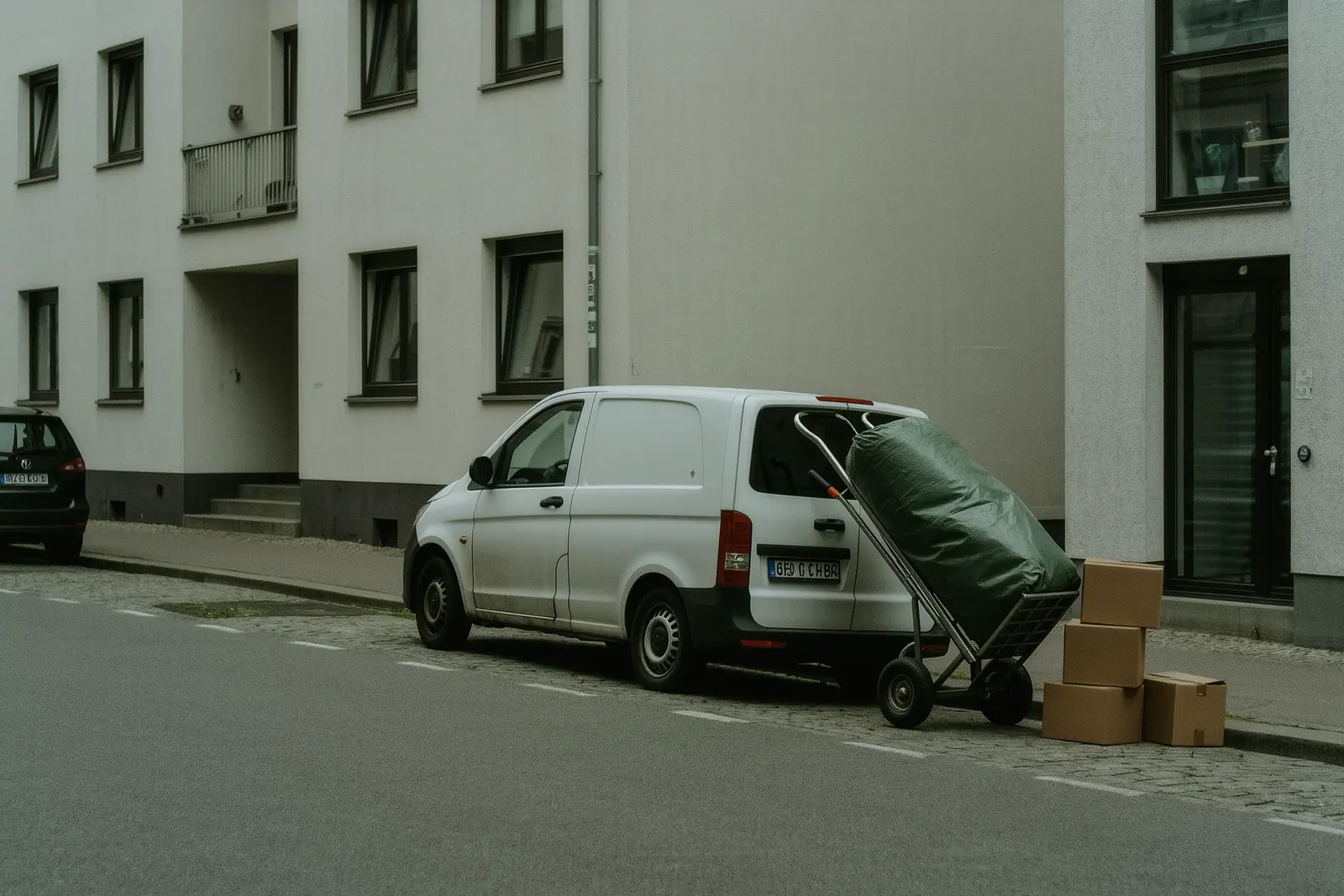
Two flats, one lease ending on the last day of the month and one starting on the fifteenth of the next. Two weeks of overlap in the wrong direction, and somewhere in the middle a van, a sofa, eleven boxes and a bicycle that has to live somewhere.
That is the ordinary shape of a Frankfurt move, common enough that the storage market here is well developed and, in the central districts, priced comfortably for the operator rather than for you.
Size it properly, once
The most expensive mistake is renting the wrong size, because changing unit mid-contract means moving everything twice.
Do not estimate in rooms. Estimate in cubic metres:
- A standard moving box is roughly a twentieth of a cubic metre. Forty boxes is about two cubic metres, stacked.
- A three-seat sofa: one and a half to two cubic metres, and it does not stack.
- A double mattress on its edge: under half a cubic metre, and useful as a wall.
- A wardrobe, dismantled: under a cubic metre. Assembled: three, and it will not go through the unit door.
- A bicycle: half a cubic metre hanging, more lying down.
| Unit size | Roughly holds | Realistic use |
|---|---|---|
| 1–2 m³ | A locker’s worth of boxes and small items | Documents, seasonal things, a bike |
| 3–5 m³ | A studio, or one furnished room | One person between flats |
| 6–8 m³ | A small one-bedroom flat | The standard short-let overlap |
| 10–15 m³ | A two-bedroom flat | A family move with a gap |
| 20 m³ and up | A household, or business stock | Exhibition kit and event equipment |
Add a third to whatever you calculate. A unit packed solid to the door is a unit you cannot get anything out of, and if you will need one box in week three, you need an aisle.

Where the site is, and what that costs
Storage prices here follow the same geography as everything else. Sites inside the inner districts — handy for Bornheim, the eastern end and the areas around the centre — carry a clear premium. Sites out by the motorway junctions, in the industrial belts east and west, or south across the river, cost substantially less for the same volume.
The calculation is straightforward. If you already have a van for the move, the extra twenty minutes each way to an outer site costs an hour of van time once and saves a difference that repeats every month. If you are moving in stages by car over several weekends, the central site wins, because you will make six journeys rather than one.
One more variable: the unit itself. A ground-level unit you can reverse a van up to is worth more than a cheaper one on the second floor, reached by a single goods lift shared with everyone else moving in on a Saturday in July.
The contract terms that catch short users
Storage agreements are written for people who stay a year. Three clauses catch everyone who does not.
Notice. Ending the contract usually needs notice, commonly two weeks and sometimes to the end of a month. Give it as soon as you have signed the new lease, not when the unit is empty.
Minimum period. Some operators set one. A four-week minimum against a three-week need is fine. A three-month minimum is not, and it should be asked about before you compare monthly prices.
Insurance. Usually mandatory, often sold on site, and frequently duplicating cover you already hold. Read your household policy for goods in professional storage before buying the operator’s product.
When the city is busy
Storage demand peaks with the moving season, roughly March to September, and it concentrates at the end of each month around the usual lease turnover dates. Vans are hardest to hire on the last Saturday of a month, so a move planned for the thirty-first is a move planned in the worst conditions the calendar offers.
Shift the van day to a mid-month weekday and everything gets easier and cheaper at once. If you cannot, book the unit and the van together, several weeks out.
Two other uses worth knowing
Storage is not only for moves. People arriving on a posting with a furnished flat usually need somewhere for the things a furnished flat has no room for: winter kit, sports equipment, boxes shipped ahead. A small unit for the length of the posting is cheaper than a larger flat, and much cheaper than a larger flat in Bornheim or Sachsenhausen.
And for anyone exhibiting more than once a year, a unit near the city is the standard alternative to paying an empties service at every event. It turns the hall logistics problem into a van booking, which is a problem with a known price and a known duration.
The habit that pays for itself
Number every box and keep the list on your phone, with a photograph of each one open before it is taped shut. It takes ten minutes at packing time. It is the difference between finding the right box in four minutes on a Tuesday evening and unstacking a whole unit in the dark because the passport is in one of forty identical cartons.
What to check before you book
- Measure what you are storing rather than describing it. Cubic metres, not rooms.
- Check the access hours, and whether round-the-clock access costs extra or does not exist at that site.
- Ask about the notice period to end the contract. Two weeks is common; a full month is not unusual.
- Confirm whether the unit is at ground level, on a goods lift, or up a flight with a trolley.
- Ask what insurance is required, whether the site sells it, and whether your own contents policy already covers goods in storage.
- Check whether a van can stand at the door, for how long, and whether trolleys are provided.
- Establish whether the site is dry and heated if anything wooden or electronic is going in for months.
Questions people actually ask
- What size storage unit do I need for a two-room flat?
As a working figure, a small one-bedroom flat packs into roughly six to eight cubic metres and a larger two-bedroom into ten to fifteen. Those numbers assume boxes rather than loose items and stacking to the ceiling. Sites publish size guides in room equivalents, which flatter the space, so measure your own furniture and then add about a third for access.
- How much does storage cost in Frankfurt?
It is priced per unit per month and varies far more by location than by operator. Sites in the inner districts charge a clear premium over sites out towards the motorway junctions or in the industrial belts east and west of the city, often close to double for the same volume. If you have a van for the day anyway, the outer sites are the obvious economy.
- Is my property insured while it is in storage?
Not automatically. Most sites require insurance as a condition of the contract and will sell you a policy, and some household contents policies extend to goods in professional storage for a limited period. Check your own cover first, because buying insurance you already hold is a common and avoidable cost. Whatever you arrange, keep an inventory with photographs.
- Can I get into the unit at any time?
It depends on the site. Many operate long daytime access with the gates locked overnight, and only some offer entry around the clock, sometimes at a higher rate. If your move involves an evening van run, which most do because that is when help is available, confirm the hours before booking rather than finding out at nine at night with a loaded van.