GearFrankfurt
What a formalwear hire fitting actually needs from you
Sep–Dec, Feb–Apr
A fitting for hired formalwear takes twenty minutes if you arrive prepared and three appointments if you do not. What to bring, the four numbers worth knowing in advance, what an alterations room can and cannot do to a garment that has to go back, and how late is too late.
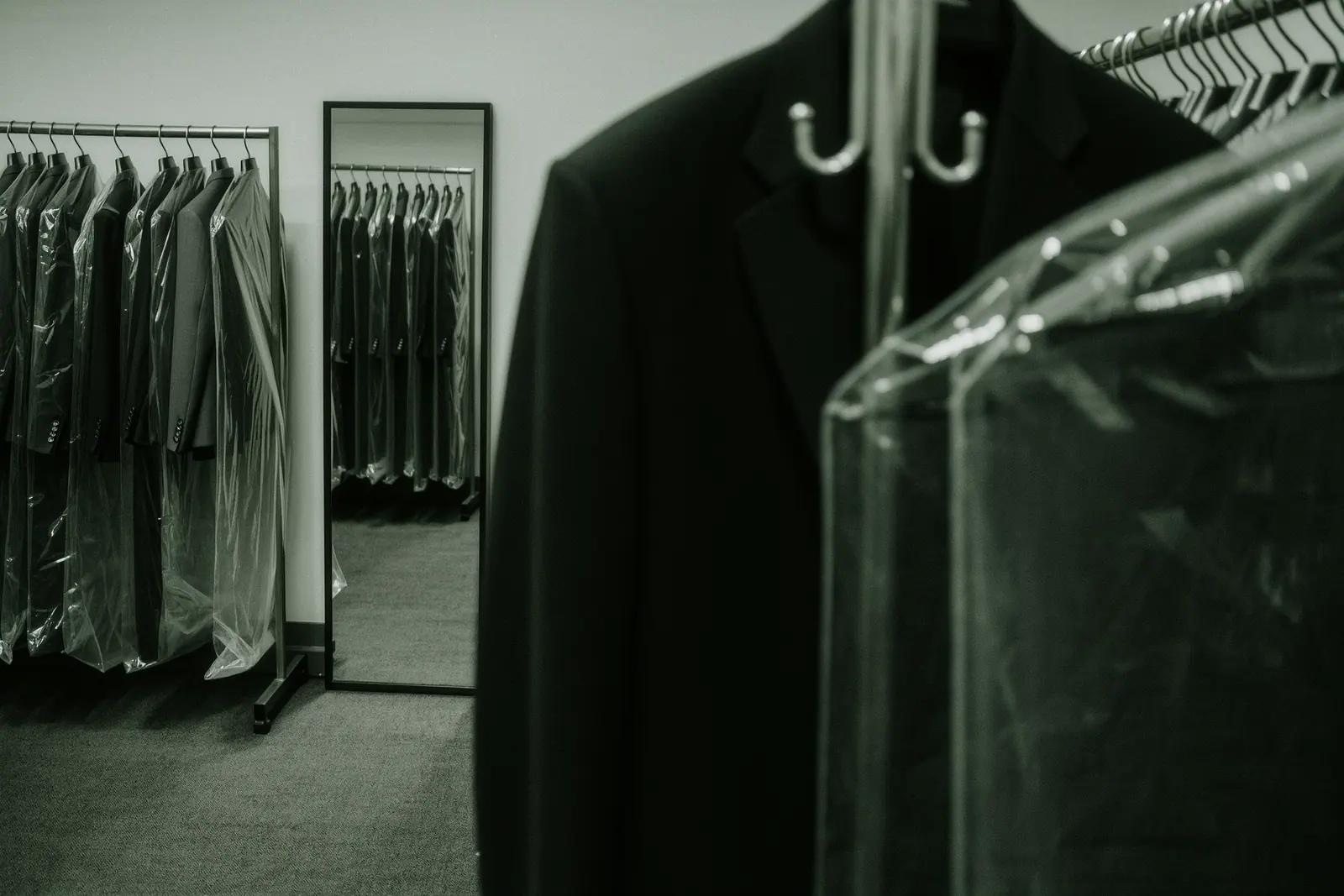
Two men book a fitting for the same Thursday. The first arrives in trainers, without a shirt, and does not know his inside leg. The second brings his own black oxfords in a bag. The first will be back twice. The second will be out in twenty minutes with a garment that fits.
That is most of what there is to say about formalwear fittings, but the detail is worth having, because in Frankfurt the constraint is almost never the garment. It is the alterations room, and the alterations room is a queue.
The four numbers
Know these before you walk in. They will be measured again, and that is fine — knowing them means you can be told over the phone whether the shop has anything in your size before you spend an afternoon finding out.
| Measurement | Taken where | Why the shop wants it |
|---|---|---|
| Chest | Around the fullest part, under the arms, relaxed | Sets the jacket size, which is the whole fitting |
| Waist | At the natural waist, where trousers sit, not at the hips | Sets trouser size and whether braces are needed |
| Inside leg | Crotch to the top of the shoe, in the shoes you will wear | The single most altered dimension |
| Neck | Around the collar line, one finger of slack | Decides the shirt, which decides the collar |
Two more help: your height, and your usual jacket length if you know it — short, regular or long. A regular in a chest size that is right for you can still be wrong if you are tall, and length is not something an alterations room can add.
What to bring, and why each item
The shoes. Trouser length is set from the top of the shoe. Set it in trainers and the trousers will be short on the night. This is the item people forget and the one that causes the second appointment.
The shirt. A jacket sleeve should show a centimetre or so of cuff. Without a shirt in the room, the sleeve is set from a guess about a shirt you have not bought yet.
Braces, if you use them. They change where the trouser waist sits, which changes the length. Belt or braces has to be decided in the fitting room, not on the evening.
The dress code, in writing. “Black tie” and “black tie optional” send you to different rails, and so does anything unusual — a themed evening, a colour request, a family occasion with its own conventions. The difference between the codes is worth settling before the appointment rather than during it.
What the alterations room can do
Routine and quick:
- Trouser hem, taken up or let down within the fabric available.
- Trouser waist, in or out by a modest amount.
- Jacket sleeve length, which is a real alteration and takes time.
Sometimes, sometimes not:
- Taking in the jacket body at the side seams. It depends on the garment and on whether the shop is willing to do work that has to be undone afterwards.
- Trouser seat and leg taper, for the same reason.
Effectively never:
- Shoulders. If the shoulder seam sits inside or outside your own shoulder point, the jacket is wrong. Ask for another one rather than accepting a promise.
- Jacket length. A jacket that is long on you stays long.
- Collar gap. A jacket collar standing away from the back of your neck is a fit problem in the body, and on a hire garment it is not going to be solved.
The honest test in the mirror: shoulder seam on the shoulder, collar flat against the shirt, one button done up with a flat hand’s clearance, cuff showing, trouser touching the shoe once and stopping. Everything on that list except the last two is a rail decision, not an alterations decision.
Sit down, and raise your arms
Fittings are done standing still in front of a mirror, and evenings are not. Before you accept a jacket, sit in it, reach forward as if for a glass, and lift both arms. If the jacket pulls hard across the back or the collar jumps off your neck when you reach, the fit is too close for a long evening in a warm room.
Do the same with the trousers seated. A waist that is fine standing and painful sitting is a waist that needs letting out, and that is a five-minute conversation in the shop and an unpleasant four hours otherwise.
Timing, backwards from the event
- Four weeks out — call, give your measurements, ask what is available and book the fitting. In November or a fair week, do this at five or six weeks. Those are the same weeks that make an apartment in this city expensive, and for the same reason: too many visitors wanting the same thing at once.
- Two to three weeks out — the fitting itself. Alterations agreed and dated in the room.
- Three to five days out — second fitting, everything tried on together, including shoes and shirt. This is the buffer that lets a mistake be fixed.
- The day before — collection. Hang the garment straight away and unfold the trousers; a garment bag left flat overnight creases along the fold and there is no time to press it.
- Within the return window — back, uncleaned. Cleaning is the shop’s job and doing it yourself usually voids the arrangement.
The buffer at step three is the whole point. Everything in a hire fitting can be solved with a working day in hand, and almost nothing can be solved at six in the evening on the day itself, when the shop has already closed and you are due in the district at seven.
What to check before you book
- Book the fitting the moment you have a date. The garment can be found late; the alterations room cannot.
- Bring the shoes you will wear on the night. Trouser length is set from the shoe and from nothing else.
- Wear or bring the shirt you intend to use, so the sleeve shows the right amount of cuff.
- Know your chest, waist, inside leg and neck in centimetres before you arrive.
- Ask what can be altered on this specific garment and what is fixed, before you accept it.
- Agree the second appointment in the room, with a date, rather than leaving it to a phone call.
- Sit down in the jacket and raise both arms. A fitting done standing still tells you nothing about a four-hour evening.
Questions people actually ask
- What should I take to a formalwear fitting?
The shoes you will wear, the shirt if you own one, and any braces. Take your measurements written down, and take the invitation or at least the exact dress code wording. If the event has a photographer or a specific colour requirement, mention it at the start rather than at the end, because it can change which garment comes off the rail.
- How much can a hired garment be altered?
Trouser length and waist, and jacket sleeve length, are routine. Taking in a jacket body is sometimes possible and sometimes refused, because the alteration has to be reversible for the next hire. Shoulders are effectively fixed — a jacket whose shoulder seam does not sit on your shoulder is the wrong jacket and no alteration will rescue it.
- How late can I leave it?
A common size in a quiet month can be handled inside a week. In the last fortnight of November, or in a big fair week, a week is not enough and you may be choosing from what fits rather than what you wanted. Two to four weeks is the sensible window, and it is the alterations queue rather than the stock that sets it.
- Do I need a second appointment?
If anything is being altered, yes, and it is usually short. Some shops combine the second fitting with collection the day before the event, which is efficient but leaves no time to fix a problem. If your event matters, take a second fitting a few days before collection so there is a working day in hand.