On the waterFrankfurt
Why self-drive boat hire barely exists on the Main
Apr–Oct
Visitors arrive expecting the licence-free day boat they hired on a Mediterranean coast or on still water further north. It is not here, and the absence is structural rather than accidental. What the river actually is, what you can steer yourself nearby, and when to just hire the skipper.
Somebody who hired a licence-free day boat on a Spanish coast last summer, or a small motorboat on the lakes and canals further north, arrives here and looks for the same thing. It is not on offer, and the assumption is that the market has simply not caught up.
The market has caught up. There are four structural reasons and none of them is going to change.
One: it is a working waterway
The Main through Frankfurt is a federal waterway carrying commercial cargo. Barges and push-tows use a marked channel, they have priority, and they cannot take avoiding action for a small craft that has misjudged a crossing. There is a set of traffic rules for inland waterways that governs all of this, and it assumes everybody on the water knows it.
That is a reasonable assumption for a professional skipper and an unreasonable one for a visitor who was handed a laminated card twenty minutes ago.
Two: the locks are worked for commercial traffic
The city sits in an impounded reach between a barrage downstream at Griesheim and another upstream at Offenbach. Inside that reach you can move about twenty kilometres without locking, which is the basis of every hired trip here — the detail is in hiring a boat on the Main.
Beyond it you lock. Locks on this river are operated around commercial movements, and a small craft goes through when there is room, which may be soon or may be an hour. Nobody can sell a timed self-drive hire against that.
Three: there is nowhere to stop
This is the one that actually kills it.
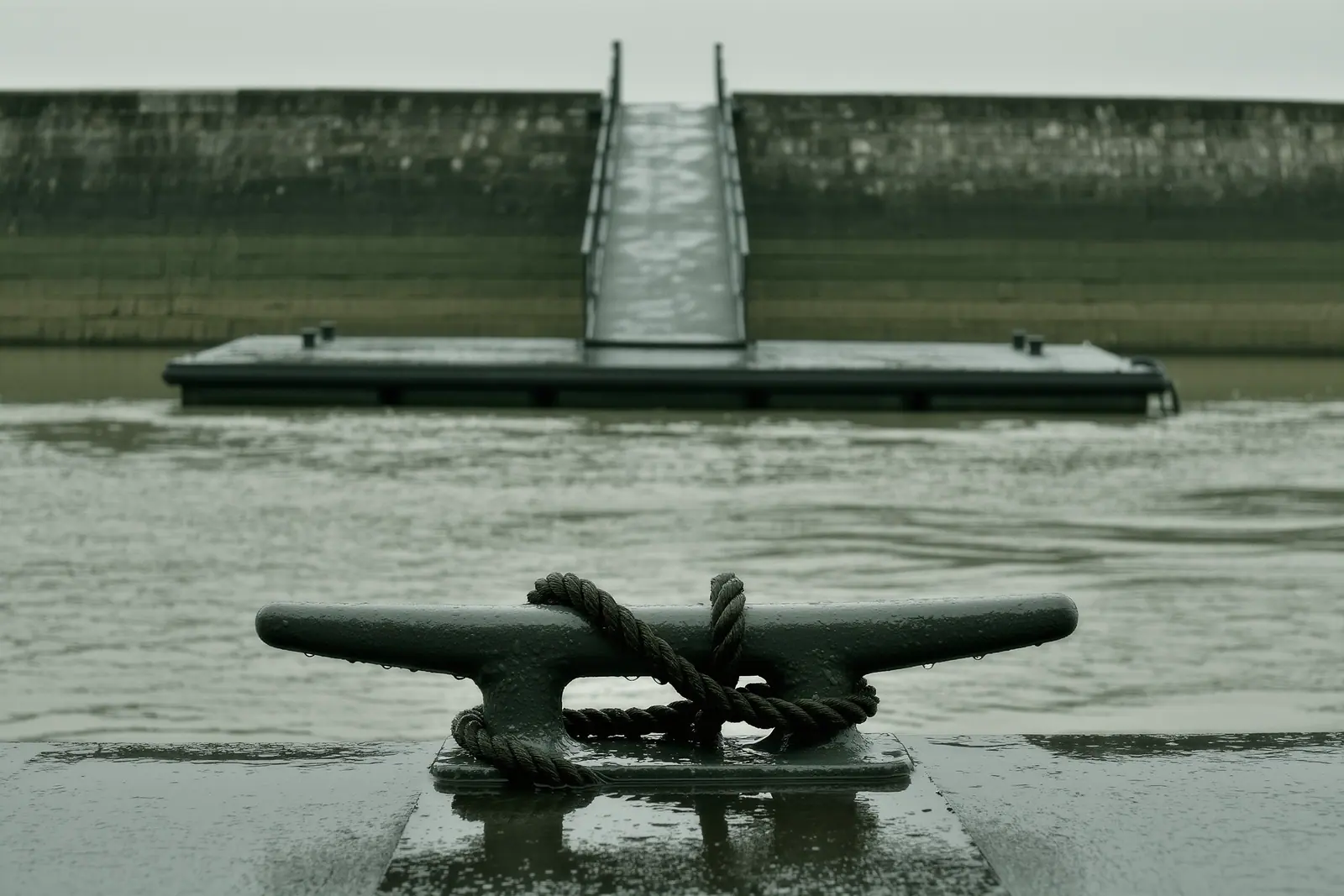
A self-drive hire needs three things: somewhere to start, somewhere to break the journey, and somewhere to come back to. Through the centre the banks are vertical embankment wall, built for flood protection on a river that rises. The pontoons that exist are few and are largely worked by passenger operators throughout the day.
So even if you had the craft and the licence and the confidence, you would be driving a boat up and down a reach with nowhere to tie up, which is not a day out. It is a commute without a destination.
Four: licence, insurance and deposit
The requirement for a licence on inland waters is set nationally and keyed to engine power, which is what makes the licence-free model possible elsewhere on low-powered craft in benign water. Confirm the current threshold directly rather than trusting any summary, including this one.
Insurance is the quieter obstacle. Cover for a self-drive craft on a commercial waterway is a different product from cover on a lake, priced differently and written with different exclusions, and the deposit that goes with it is substantial. Add the cost of a base with pontoon rights in a city centre and the business case disappears before the first customer arrives.
What you can steer yourself
| Option | Where | Needs | Honest verdict |
|---|---|---|---|
| Canoe or kayak from a club | Quieter reaches, off the channel | Membership or a day arrangement | Genuinely good; ask which reaches |
| Paddleboard | Not the centre channel | Sense | Poor idea where the barges run |
| Small electric boat | Still water outside the city | Little or nothing | The closest thing to what you wanted |
| Hire boat on the Lahn | An hour or so north-west | Licence rules differ; check | A real self-drive tradition, human-scale locks |
| Boat with an accompanying skipper | The Main itself | Nothing from you | Steer under supervision, legally |
That last row is worth knowing about, because it is rarely advertised. Several operators will put a skipper aboard a small boat and let you take the wheel for part of the trip under their supervision. It is not the same as being alone on the water, but it puts the tiller in your hand on the river you came to see.
The wash, not the current
One practical note for anyone who does end up self-propelled on this river. In normal conditions the impounded reach flows gently and the current is not the problem. Two other things are.
The first is wash. A loaded push-tow displaces a great deal of water and the wave that follows it arrives at the bank thirty seconds after the vessel has gone by, which is exactly when a novice has relaxed. Take it on the bow.
The second is rain that fell somewhere else. Flow here responds to weather far upstream, so the river can be running faster than the sky above you suggests. Check the level, not the forecast.
What to do instead
If the point is to be on the water in Frankfurt, hire the small boat with a skipper and take it upstream in the evening. It costs less than most people expect and it is the best two hours available on this river.
If the point is to steer, drive an hour. Still water, a small electric boat and a picnic will give you the afternoon you were imagining, and it pairs neatly with the kind of weekend covered in campervan hire for a Taunus weekend. Trying to have that afternoon between two barrages in a shipping channel is the one version that will not work.
What to check before you book
- Ask what licence the specific craft requires and confirm the current national threshold rather than relying on a summary.
- If a hire is offered on the Main itself, ask where you may moor. A boat with nowhere to stop is not a day out.
- Check the insurance product and the deposit before anything else — self-drive on a commercial waterway is not the same cover as on a lake.
- For a canoe or kayak, ask the club which reaches they consider sensible and stay off the marked channel.
- Watch the weather upstream, not overhead. Flow on this river rises after rain that fell somewhere else.
- If steering is the point, price the drive to still water. It is usually under an hour and it changes everything.
Questions people actually ask
- Can I hire a small motorboat without a licence in Frankfurt?
Not in any practical sense. The licence-free model works where the water is still and the craft are low-powered, and the threshold that permits it is set nationally by engine power rather than by the operator. On a busy commercial river with a marked channel and barge traffic, operators do not build a business around handing those craft to strangers, and there is nowhere in the city to keep a fleet of them. Verify the current threshold before you plan around any of this.
- Why are there so few moorings in the city?
Because the banks through the centre are vertical embankment wall, built for flood protection and for a working river rather than for leisure craft. The pontoons that exist are few and mostly allocated to passenger operators who use them all day. A self-drive hire needs somewhere to start, somewhere to stop and somewhere to return to, and the middle one of those simply is not available here.
- Is the Main dangerous for small craft?
It is not dangerous in the way an open coast is, but it is unforgiving of inattention. Commercial vessels are large, they cannot manoeuvre around you, and the wash from a passing push-tow catches people out more than the current does. Flow increases after rain that fell upstream, which is not the weather you can see. None of this is beyond a competent person; all of it is beyond a first-timer with an hour of instruction.
- Where can I actually steer something myself near Frankfurt?
Canoes and kayaks from clubs on the quieter reaches, small electric boats on still water outside the city, and hire boats on the Lahn, a smaller river to the north-west that has a genuine self-drive tradition and locks worked at a human pace. Any of those is under two hours away, and all of them deliver the thing people actually want, which is the tiller in their own hand.