On the roadFrankfurt
Picking up a hire car at the airport and getting out fast
All year
The counters are not in arrivals, the cars are on a deck above them, and the exit puts you onto a motorway that only goes one way. What the walk from each terminal really takes, the order to do things in at the bay, and why the hall calendar decides how long you queue.
The aircraft parks at Terminal 2, you are off it in eleven minutes, and then you spend forty more reaching a car that was ready before you landed. That gap is the whole story of hiring a car at this airport. Nothing about the process is slow in itself. The distances are.
Get the geography right and the rest of it is straightforward. Get it wrong and you lose an hour before you have driven a metre.
The counters are in a car park
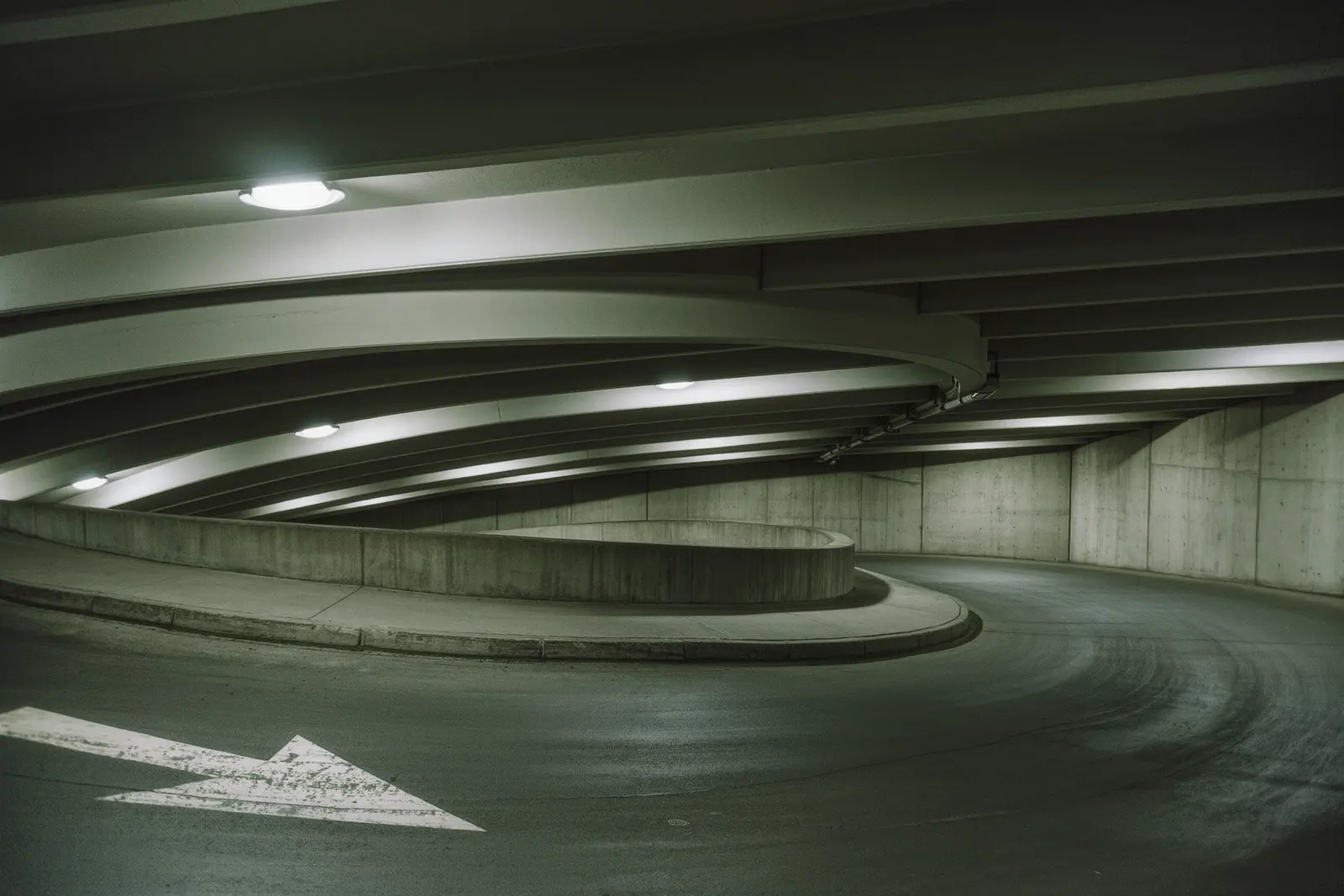
The rental desks here are not in arrivals. They are inside a parking structure on the Terminal 1 side, reached through a link from the terminal, with the cars themselves on the decks around and above the counters. That arrangement is efficient once you are in it — the walk from counter to bay is short — but it is invisible from the arrivals hall, and the signage assumes you already know where you are going.
The practical consequence is that your arrival terminal decides your first hour.
| You land at | Getting to the counters | Add for this |
|---|---|---|
| Terminal 1, concourse A or Z | Shortest walk, mostly indoors | Baggage reclaim |
| Terminal 1, concourse B or C | The length of the terminal on top | Moving walkways help, bags do not |
| Terminal 2, concourse D or E | Shuttle train, then the Terminal 1 walk | 15–25 min, plus waiting for the shuttle |
| Long-distance train | You arrive under Terminal 1 already | The least painful arrival of the four |
The shuttle between terminals is automated and frequent, but it is a train with a platform, a wait and a walk at both ends. There is a bus as well, which is slower and useful mainly when the train is out of service.
The order to do things in at the bay
The deck is where people rush, and it is the one place where two minutes buys you real protection.
- Read the sheet against the car before you touch anything. Registration, fuel level, mileage. If the sheet says full and the needle says seven-eighths, that is a conversation to have now, not on the invoice.
- Photograph with the flash on. Deck lighting is strip lighting overhead, which flattens exactly the kind of scuff that later becomes a charge. Shoot all four corners, both bumpers, the wheels and the windscreen.
- Photograph again at your first daylight stop. A service area on the A3 twenty minutes later gives you a second, honest set. This is the step that settles arguments.
- Check the required kit. Warning triangle, high-visibility vest and first aid kit are expected in the car. Whether every item is legally mandatory for your journey is set nationally and worth confirming, but a car missing all three is a car that has not been checked over.
- Find the emissions sticker on the windscreen and know what class it is. Nearly every German-registered hire car carries one, but the class matters if you are driving into the city — see the low-emission zone and rented vehicles.
- Set your first junction before you move. Not your destination. Your first junction.

The exit is where people actually lose time
The decks feed a perimeter road, and the perimeter road feeds two of the busiest motorways in the country within a couple of kilometres. There is no gentle suburban buffer in which to work out where you are going.
The four choices, in the order they appear:
- A5 north for the city, the western districts and, further on, the run towards Kassel.
- A5 south for Darmstadt, Mannheim and the long road to Basel.
- A3 west for Wiesbaden, Mainz and Cologne.
- A3 east for Offenbach, Hanau, Würzburg and Nuremberg.
The lanes commit early at the big interchange south of the airport, and a wrong choice there is not a quick correction: the next turn-round on either motorway is several kilometres away, through traffic that is heavy at almost any hour. If the city centre is your destination and the A5 is stopped, the B43 through Kelsterbach is the slow but reliable alternative, and it is worth having in mind before you need it.
The fair calendar decides your queue
Frankfurt does not have a summer rental peak in the way a coastal city does. It has a hall calendar. In the weeks of the large fairs — the consumer-goods weeks in late winter, the technical fairs that run in alternate springs, the publishing week in October — the counters at this airport are the busiest they get, the fleet is drawn down across the whole region, and the categories that survive are the ones nobody wanted. The build-up and break-down weeks either side are worse than the public days, because that is when the vans and estates go.
If your trip lands in one of those weeks, book early and read car hire during the big fair weeks before you choose your depot. The booking window for this city tracks the halls, not the weather.
When not to collect here at all
If you are staying in the centre for four days and driving on one of them, the airport is the wrong pickup. You will pay a location surcharge on every day of the rental, and then pay again to store the car in a city deck by the hour while it sits unused. Collecting from a city depot on the morning you actually drive is usually cheaper and always less walking — the comparison is set out in airport or city depot.
The airport earns its premium in exactly two situations: you land late or leave early, when the city depots are shut, and you are driving straight out of the region, when being on a motorway within two minutes is worth real money.
What to check before you book
- Check which terminal you land at before you book, and add the shuttle to your plan if it is Terminal 2.
- Confirm whether the counter is staffed at your arrival time or whether the pickup is a kiosk and a key box.
- Ask for the vehicle category in writing, not the model, and check the emissions class of the actual car against the city zone rules.
- Photograph the car in the bay with the flash on, then again outside in daylight at your first stop — deck lighting hides scratches.
- Confirm the legally required kit is aboard — warning triangle, high-visibility vest, first aid kit — before you leave the level.
- Set your first motorway junction on the phone before you release the handbrake. The ramp puts you on a slip road within about a kilometre.
- If two of you will drive, add the second driver at the counter rather than sorting it out later.
Questions people actually ask
- Where are the car hire desks at Frankfurt airport?
They sit inside a parking structure on the Terminal 1 side rather than on the arrivals floor, with the cars on the decks around them. You follow signs out of the terminal and through a link building to reach them. From Terminal 2 you first take the shuttle train across, which is why arrival terminal matters more here than at most airports. Check which terminal your flight uses before you plan your first hour.
- How long does it take to get from landing to driving away?
On an ordinary day, forty to sixty minutes from the aircraft door if you have hold baggage and land at Terminal 1. From Terminal 2 add fifteen to twenty-five minutes for the shuttle and the extra walking. During a big fair week the counter queue alone can match the whole rest of the process, so treat those weeks as a different calculation.
- Do I need an International Driving Permit?
An EU or EEA licence is accepted as issued. Licences from outside that area are commonly accepted alongside an International Driving Permit, and some desks insist on a certified translation regardless of the legal position. The requirement is set nationally and applied by the company, so confirm it for your specific licence before you fly, and carry the physical card either way.
- Can I collect a car at the airport and return it in the city?
Usually yes, within the same network, and the fee is often modest because the airport is where the fleet wants to be anyway. It has to be arranged at booking rather than on the day, and the receiving depot has to be open when you arrive. City depots commonly close on Sundays, which catches people out on a weekend drop.